
 עברית
עברית You implant in me your true karmic will for my healing, and I implant in you my true will of your healing. And out of this mutual impulse of healing, we work on transforming our shared karma. Thus, the new moral will of human beings circulates through the soul of each other.
Growing Together: The Reversed Cultus and Co-Creative Evolution
‘It is a fundamental maxim of occultists to see the other person as the revelation of one’s own Higher Self, because he knows then he must find the other in himself.’
God and Humanity in an Evolving Universe: Rudolf Steiner’s Christology and the Knowledge Drama of the Second Coming in the Work of Yeshayahu Ben-Aharon
Torbjørn Eftestøl and Jeremy Qvick
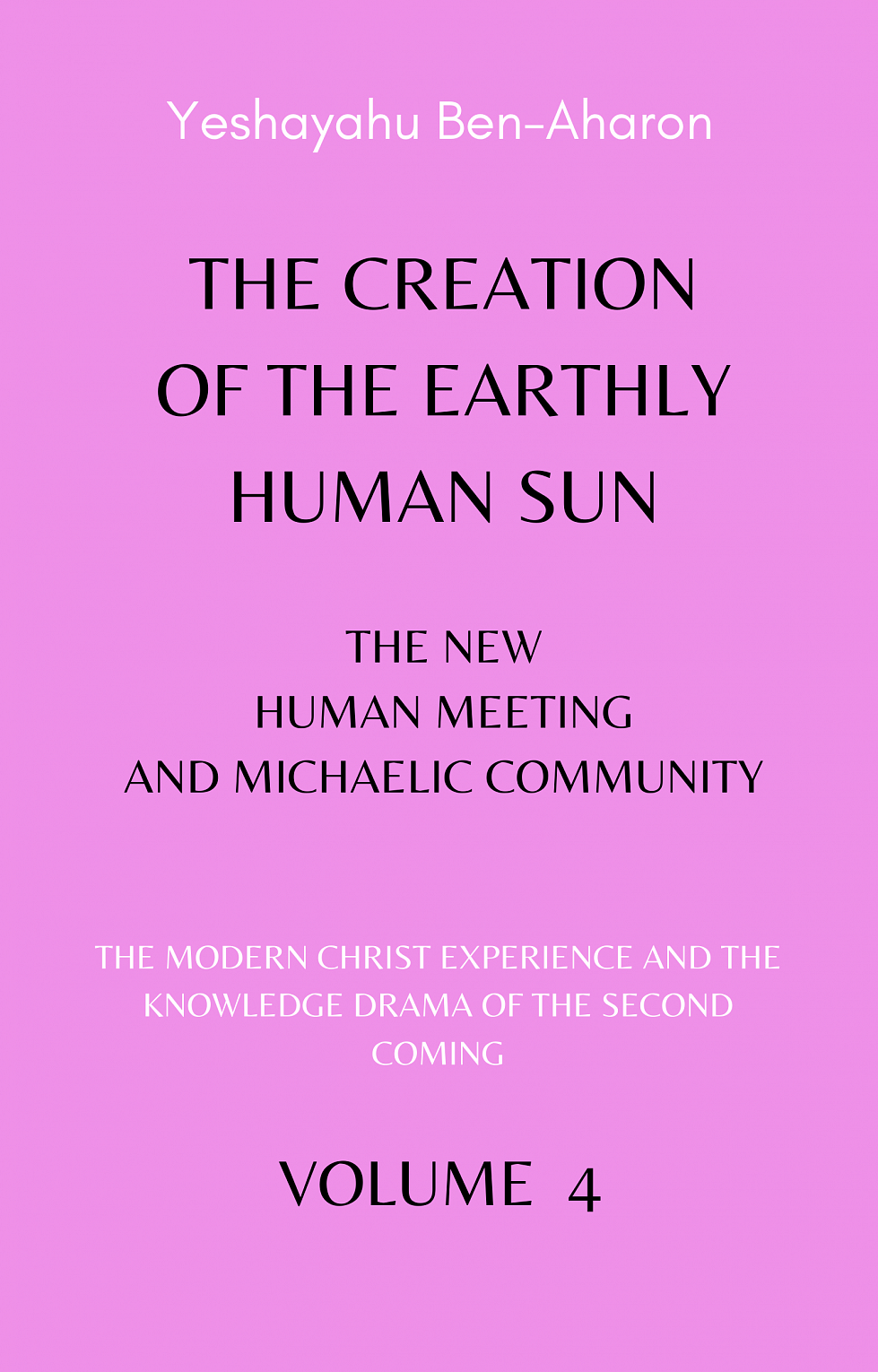
Ben-Aharon describes how such processes can become the foundation for creating a new community. The more individuals are mutually offering their self-consciousness and soul—and eventually bodies as well—to allow the etheric Christ to dwell among them, the whole community is resurrected and lives in each one of the members, and each member lives in the spiritualized consciousness of every individual. In this way, individual spiritual development and communal formation and development mutually strengthen and enhance each other. The fruits of the work of each individual are shared among the community. Thus, the spiritual development and learning of individual members become communalized, and everyone receives the fruits of the work of the whole community. These fruits are multiplied through the individualization process of each member and can be offered back to the source, to the spiritual world.
God and Humanity in an Evolving Universe: Rudolf Steiner’s Christology and the Knowledge Drama of the Second Coming in the Work of Yeshayahu Ben-Aharon
Torbjørn Eftestøl1,* and Jeremy Qvick2
1 Rudolf Steiner University College, 0260 Oslo, Norway
2 The Global Event College, 72074 Tübingen, Germany*
Religions2026, 17(3), 395;https://doi.org/10.3390/rel17030395
This article belongs to the Special Issue Divine Creativity and Participatory Cosmologies: Theological Perspectives on Science, Technology, and the Future of Humanity
- Growing Together: The Reversed Cultus and Co-Creative Evolution
In the knowledge drama of the Second Coming, Ben-Aharon portrays how the Christ can be individualized through a stepwise process of the spiritualization of thinking, feeling and will, so that the Pauline words increasingly become a reality: ‘I have been crucified with Christ and I no longer live, but Christ lives in me’ (Gal 2:20). When the ordinary self dies to itself, the individual experiences how his or her ‘true Ego—Christ’s given Ego—will come to meet him ‘out of the cosmos.’ Only then do we find out that ‘this is indeed the case… out of a yet unknown world… our real Ego…. comes toward us’ (Ben-Aharon 2022, p. 73).
Through this possibility of transforming self-consciousness from self-centeredness to a ‘self-less self-consciousness’ a new kind of community can be formed. The foundation and source of this lies in the individuation of Christ’s Ego as the universal Higher Self of Humanity. This transformative process can be intensified in the meeting with another human being and become the foundation for the creation of a wholly new community based on a new sense of responsibility for the Other. As one can allow Christ’s I to become individualized through one’s True I, so will the other human likewise become the revelation of one’s true, Higher Self.
As Rudolf Steiner pointed out, this was and is the fundamental rule of occultists and today it must become the life habit of all humans who experience concretely and consciously the weaving and pulsating of the living Christ between members of the community. In the past, only initiates knew that ‘it is a fundamental maxim of occultists to see the other person as the revelation of one’s own Higher Self, because he knows then he must find the other in himself.’ Through the fully conscious individuation of the meeting with the etheric Christ, this fundamental maxim will become the new source of life and healing, nourishing and regulating the spiritual relationships between human beings.
(Ben-Aharon 2024c, p. 87)
The ideal of this new human meeting is that both individuals awaken spiritually through the Other, offering their self-consciousness as a gift through which the other can individualize him- or herself. Both individuals can then experience how their Higher Self comes towards them through the gaze, voice and appearance of the Other. When this is done consciously together, both participants can experience a new process of individuation. Because each receives her Self through the Other, both together weave a new being, beginning to work creatively out of the Christ word: ‘For where two or three gather in my name, there am I with them’ (Matt. 18:20).
This spiritual connection, formed by a mutual offering and transformation of self-consciousnesses of both participants becomes a true gate through which also the soul elements of the Other—his or her thinking, feeling and willing—can begin to be experienced from the inside. When this happens, the human meeting becomes real participation of soul, and the speculation, interpretation and projection that fill normal social life can fall away. Because individuals can begin to sense each other’s world of thoughts, feelings and will impulses, the foundation for a new social and communal life can be created.
Based on the knowledge drama of the Second Coming, such human meetings create a new, collective state of spiritualized consciousness. When this state is consciously shared by a community of people, this spiritual-soul consciousness grows exponentially. In this way social life becomes a ‘reversed cultus.’ In The Twilight and Resurrection of Humanity: The History of the Michaelic Movement since the Death of Rudolf Steiner: An Esoteric Study (Ben-Aharon 2020), Ben-Aharon describes how such processes can become the foundation for creating a new community. The more individuals are mutually offering their self-consciousness and soul—and eventually bodies as well—to allow the etheric Christ to dwell among them, the whole community is resurrected and lives in each one of the members, and each member lives in the spiritualized consciousness of every individual. In this way, individual spiritual development and communal formation and development mutually strengthen and enhance each other. The fruits of the work of each individual are shared among the community. Thus, the spiritual development and learning of individual members become communalized, and everyone receives the fruits of the work of the whole community. These fruits are multiplied through the individualization process of each member and can be offered back to the source, to the spiritual world. Thus, a communal individuation can take place in which the ideals of freedom and love can be realized. In this future community and ‘school of love’ that the Second Coming makes possible, people will ‘learn how to embody in their hearts, souls and bodies, the whole life cycle of love, from its innocent heavenly birth, to its earthly death and spiritualized resurrection’ (Ben-Aharon 2020, p. 114). Such true social warmth of mutual recognition and responsibility is realized to the extent that each individual recognizes the Other as one’s higher Self, manifesting as ‘primordial, infinite obligation’ (Ben-Aharon 2018, p. 162).11 The past of individuation, the karma that brought us here and that created this meeting face to face, thus becomes the fertile hummus for the resurrection and creation of new moral consciousness.
You implant in me your true karmic will for my healing, and I implant in you my true will of your healing. And out of this mutual impulse of healing, we work on transforming our shared karma. Thus, the new moral will of human beings circulates through the soul of each other.
(Ben-Aharon 2024c, p. 143)
In a reversed cultus, the community ‘undergoes a process of gradual progression and spiritualization of cognition from below upwards, from the physical, to the etheric, astral and spiritual world’ (Ben-Aharon 2020, p. 263). This means that the community not only lives and works spiritually among themselves, but also takes seriously and begins to experience the higher worlds and the angelic hierarchy that constitutes it. Growing and expanding in consciousness means that each takes into their work also the beings of the third hierarchy, which Steiner outlined as the spirits formative of human soul life; Angels, Archangels and Archai. When the community consciously offers their mutual spiritualization-process to the realm of the angels, the angels can descend to become active members in the community. In Ben-Aharon’s outline of the reversed cultus, this communion creates the first rung of the ascending ladder in which humanity begins to work consciously with the spiritual hierarchy. When ‘angelic consciousness’ is created by the offering of human self-consciousness to the Other, this fruit of the human meeting can be offered as an organ of consciousness to the next level of Being. Then, this ‘astral substance’ formed within the angelic hierarchy can be raised and shared with the Archangels who create a unified communal group-self. This communal self can be further offered to Archai and the time spirit, Michael, as the Being who transforms and unites the Self of a community with the Being of humanity, the I AM. Thus, the knowledge drama and the reversed cultus together form a co-creative and sacramental epistemology which both Steiner and Ben-Aharon would see as the actualization of a new stage in humanity’s evolutionary development:
This Spiritual Science works from below upwards, stretching out its hands as it were from below upwards to grasp the hands of Michael stretching down from above. It is then that the bridge can be created between humans and the Gods.
(Steiner in a lecture from 17 December 1922, cited in, Ben-Aharon 2020, p. 124)
In the vision of the future spiritual–social life developing from working with the reversed cultus, Ben-Aharon envisions a radical shift from associative social forms to a relational ontology of the spirit. Concretely, this means the creation of a new communal organism capable of hosting a higher spiritual being. As the community grounds the experience of participating in the universal being of humanity, their shared soul life undergoes metamorphosis. This collective life is no longer bound by localized group interests or exclusive identities; instead, it expands to include the emerging universal soul of humanity—the resurrected Anthroposophia. In this sense, the community becomes the ‘chalice’ for a shared consciousness and the spiritual being of humanity that transcends the boundaries of the private or partisan ego. While this may sound like a distant ideal and, as Ben-Aharon writes, to some appear as fantasy, he makes clear that the creation of such communities is necessary for the positive evolution of humanity. Rather than a mere utopia, this vision is presented as a metaphysical horizon toward which humanity must orient itself; the ‘Second Coming’ is not a future event to be awaited, but a participatory process that must be initiated through the social and cognitive work of today (Ben-Aharon 2020, p. 119).
- Conclusions
In this article we have presented Rudolf Steiner’s Christology in an evolutionary perspective, discussing its relevance for our time through the work of Yeshayahu Ben-Aharon. According to Steiner, the 20th Century would be the time of great spiritual upheavals and transformations, rooted in a new revelation of the living Christ. Humanity would develop faculties of etheric perception, leading to a living encounter with the Christ in his Second Coming. More than one hundred years after Steiner, the question arises whether any such development can be perceived. We have presented the work of Ben-Aharon to argue for this. In our reading, Ben-Aharon represents a contemporary answer to, as well as update of Steiner’s Christology, sourced in living experience and recent epistemological developments. The two central concepts that informed this discussion were the ‘Knowledge Drama of the Second Coming’ and the ‘Reversed Cultus’ as a spiritualization of consciousness taking place both in the cognitive domain as well as ethically through the human meeting and community building. Central to these ideas are the perspective of humanity becoming a co-creative actor in cosmic evolution. Both the epistemological development as a knowledge drama, its technological–materialist challenge, and the social–moral potential of a new universal consciousness manifesting in new communities were presented as belonging to this new phase of cosmic creativity. Further analytic and comparative work is needed to contextualize and evaluate Steiner and Ben-Aharon within greater philosophical, theological and societal–cultural developments. We thus hope that this article may contribute to further critical appraisals of Steiner’s Christological work, its development in Ben-Aharon’s publications and activities, and its relevance within contemporary society and culture.